b. Container Properties
There are four container types: flat pallet, box, container, high/low flatbed truck. All have common basic properties: name, length/width/height, quantity, type, cost. Each type also has its own properties.
1) Flat pallet properties: Maximum Load Height, Extend Length Size, Extend Width Size.
① Maximum Load Height: the maximum allowed height for cargo on the pallet, including the pallet's own height.
② Extend Length/Width Size: how much the cargo on the pallet may exceed the pallet's edge in the length and width directions.
2) Boxes can be wooden or metal. Properties: external length/width/height and internal length/width/height. Internal dimensions define the container size when cargo is packed into the box; external dimensions define the cargo size when the loaded box is then packed into a container.
3) Container properties: Maximum Load Weight, Inner length/width/height, Corner-Casting length/width/height, and Reserved length/width/height.
① Maximum Load Weight: when cargo is heavy, the software automatically limits the total cargo weight to not exceed the container's maximum load for safe transport.
② Corner-casting dimensions: shown in red below. Corner castings are the two fasteners at the top corners of a container. Although they occupy little space inside the container, even experienced loading personnel, relying on their manual estimating skills, often end up with either underloaded cargo or an inability to fit everything in due to inaccurate space assessment. LoadMaster allows users to simply define the dimensions of the corner castings, and the system will automatically avoid them when generating optimized loading plans..
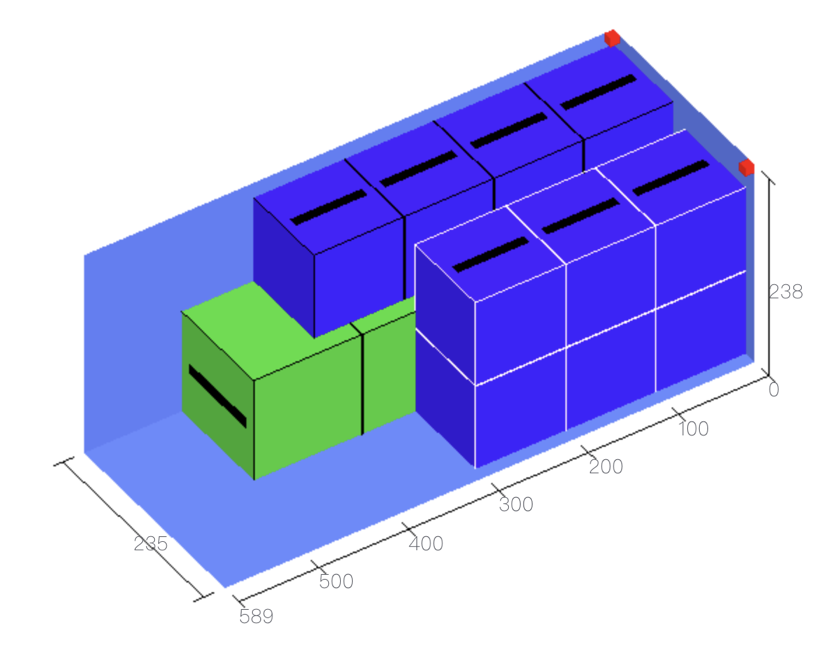
③ Reserved size: In actual loading operations, gaps between cargo items or container bulging are inevitable. To ensure that the designed loading plan is practically feasible, a certain dimensional allowance should be reserved in advance to guarantee that all goods can be fully loaded on site.
How much to deduct from container length/width/height is an empirical value. After using the software to guide on-site loading, you can summarize the recommended deduction.
If forklift loading is used, for the first-time use of the software the following reserved sizes are recommended:
- 20GP: deduct 5–10 cm from internal length, 3–5 cm from width, 10 cm from height.
- 40GP / 40HQ: deduct 13–15 cm from length, 3–5 cm from width, 10 cm from height.
For manual loading where packaging is mostly cartons, the recommended reserved sizes are:
- 20GP: deduct 5–10 cm from internal length, 3–5 cm from width, 3–5 cm from height.
- 40GP / 40HQ: deduct 13–15 cm from length, 3–5 cm from width, 3–5 cm from height.
4) High/low flatbed truck properties: Inner Length/Width/Height, and Hathpace Length and Hathpace Height.
The Inner Height is the maximum allowed cargo height. 