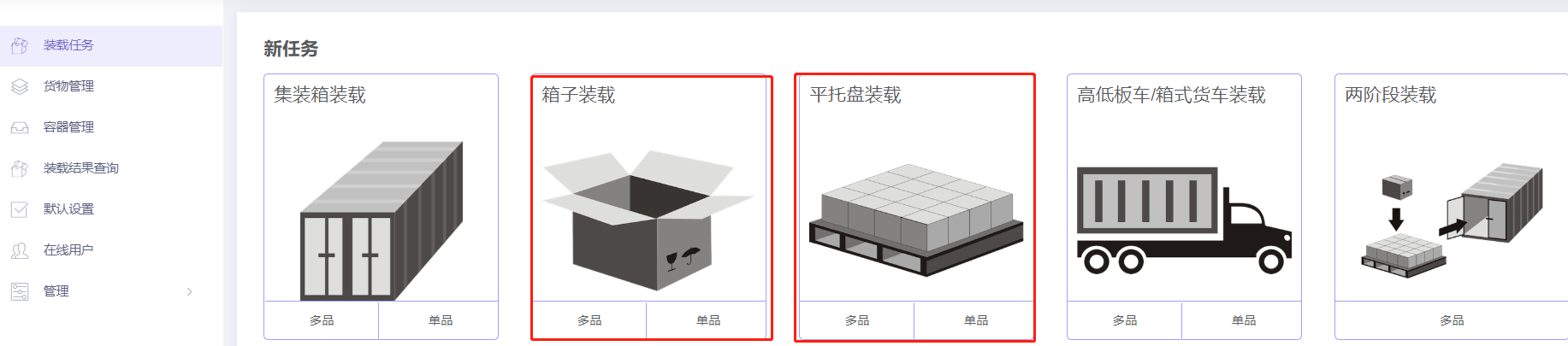
1. Single-stage first-calculation billing rule
a. Billing rule for loading cargo into containers or vehicles
1) Multiple SKUs
Users can freely enter data. During loading-optimization calculation, the system charges based on the number of cargo rows entered and the number of containers or vehicles used.
One row of cargo data is charged 2 points; one container is charged 10 points. 1 point = 1 CNY. When charging in practice, the system gives one container free, i.e. one container is not charged.
Billing formula: points = (containers used − 1) × 10 + cargo rows × 2
Example:
| Cargo name | Length (cm) | Width (cm) | Height (cm) | Cartons |
|---|---|---|---|---|
| A | 50 | 80 | 20 | 350 |
| B | 70 | 55 | 32 | 230 |
| C | 45 | 40 | 35 | 150 |
| D | 60 | 22 | 38 | 88 |
| E | 70 | 55 | 32 | 98 |
5 rows of cargo data entered, 2 containers used. Points = (2 − 1) × 10 + 5 × 2 = 20 points
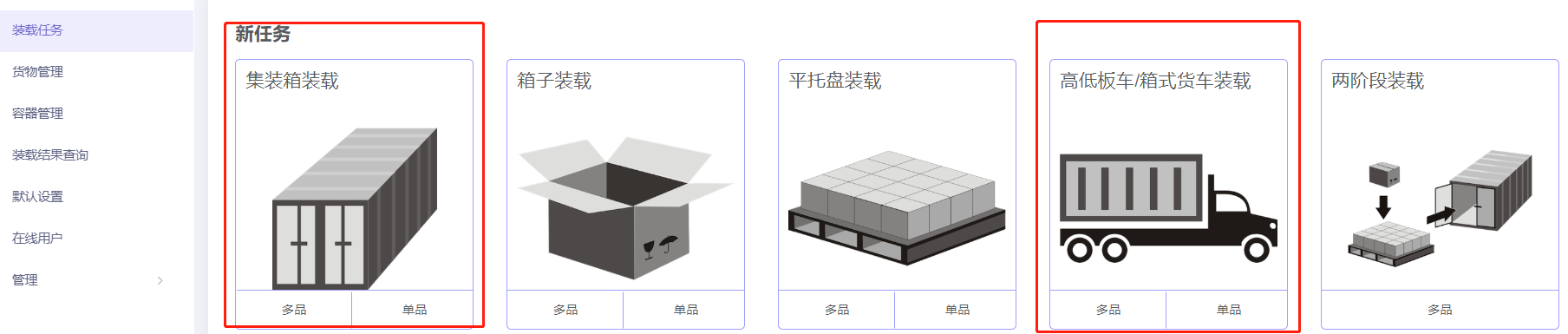
2) Single SKU
Billing formula: points = cargo rows × 2 × containers used
Example: When computing the maximum number of cartons of cargo 1 that fit in a 40HQ and a 40GP respectively, points = 1 × 2 × 2 = 4 points.
b. Billing rule for loading cargo into packing boxes (cartons, wooden cases, etc.) or pallets
Users can freely enter data. During loading-optimization calculation, the system charges based on the number of cargo rows entered and the total cargo volume.
Billing formula: total cargo volume (rounded up to the next cubic meter) × ⌈cargo rows / 10⌉ × 1 point
Example: 5 rows of cargo with a total volume of 23.5 m³ → packing points = 24 × 1 × 1 = 24 packing points.