Stacking Orders
When loading requirements involve heavy-light pairing, "heavy not on light", or "large not on small", you can set the "Stacking Orders" based on the gross weight per box, density or size of the cargo.
The "Stacking Orders" represents the cargo's bearing capability; cargo with a higher level is placed underneath the cargo with a lower level.
"Stacking Orders" is a relative value: the larger the value, the stronger the bearing capability, and the more the item goes to the bottom. The software default value is 10 for all cargo.
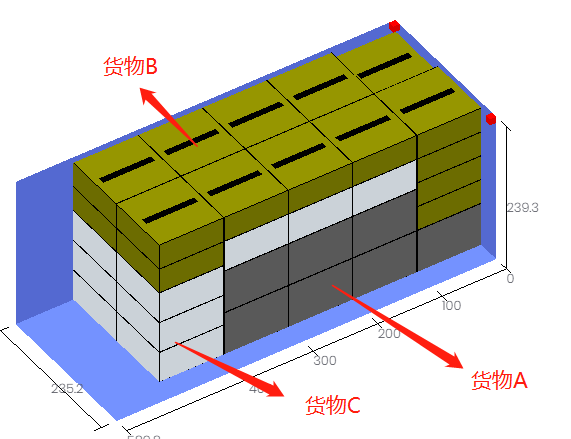
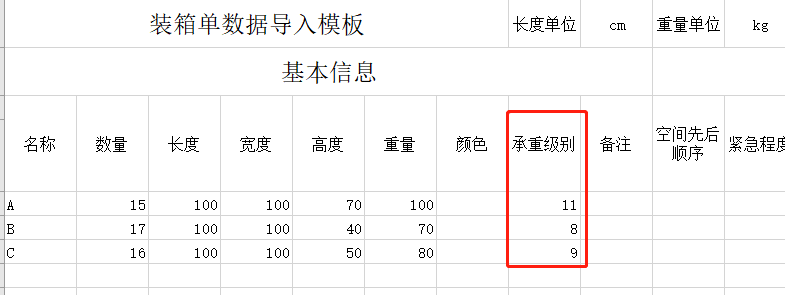
For example: cargo B cannot be pressed and must be on top; cargo A must be at the bottom. The "Stacking Orders" of A, B and C can be 13, 8 and 9 respectively. The system default value is 10.
Resulting plan: