8. Per-use and Annual Billing Rules
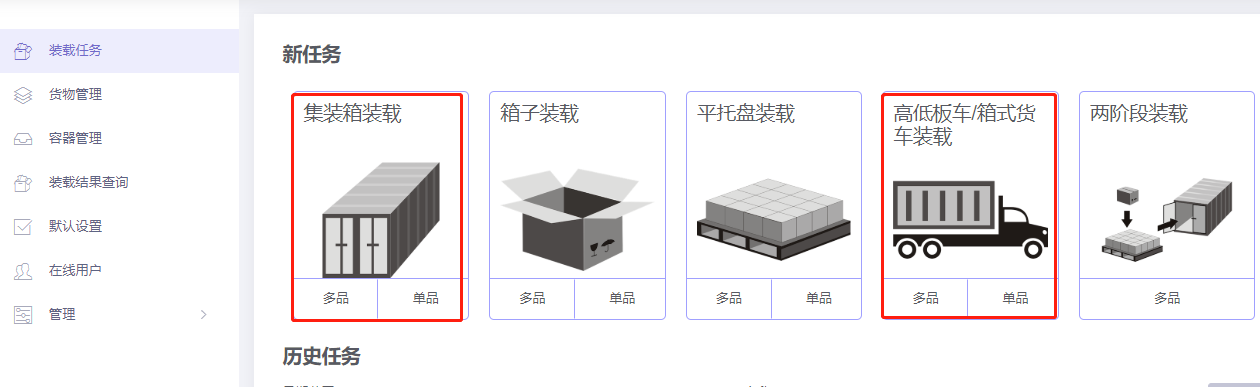
1. Single-stage — first-calculation billing rule
a. Billing rule for loading cargo into containers
1) Multiple SKUs
Users can freely enter data. During loading-optimization calculation, the system charges based on the number of cargo rows entered and the number of containers used.
One row of cargo data is charged 2 points; one container is charged 10 points. 1 point = 1 CNY.
When charging in practice, the system gives one container free, i.e. one container is not charged.
Billing formula: points = (containers used − 1) × 10 + cargo rows × 2
Example:
| Cargo name | Length (cm) | Width (cm) | Height (cm) | Cartons |
|---|---|---|---|---|
| A | 50 | 80 | 20 | 350 |
| B | 70 | 55 | 32 | 230 |
| C | 45 | 40 | 35 | 150 |
| D | 60 | 22 | 38 | 88 |
| E | 70 | 55 | 32 | 98 |
5 rows of cargo data are entered; 2 containers are used in the end. Points = (2 − 1) × 10 + 5 × 2 = 20 points.
2) Single SKU
Billing formula: points = cargo rows × 2 × containers used
Example: When computing the maximum number of cartons of cargo 1 that fit in a 40HQ and a 40GP respectively, points = 1 × 2 × 2 = 4 points.
b. Billing rule for loading cargo into packing boxes (cartons, wooden cases, etc.) or pallets
Users can freely enter data. During loading-optimization calculation, the system charges based on the number of cargo rows entered and the total cargo volume.
Billing formula: total cargo volume (rounded up to the next cubic meter) × ⌈cargo rows / 10⌉ × 1 point
Example: 5 rows of cargo with a total volume of 23.5 m³ → packing points = 24 × 1 × 1 = 24 packing points.
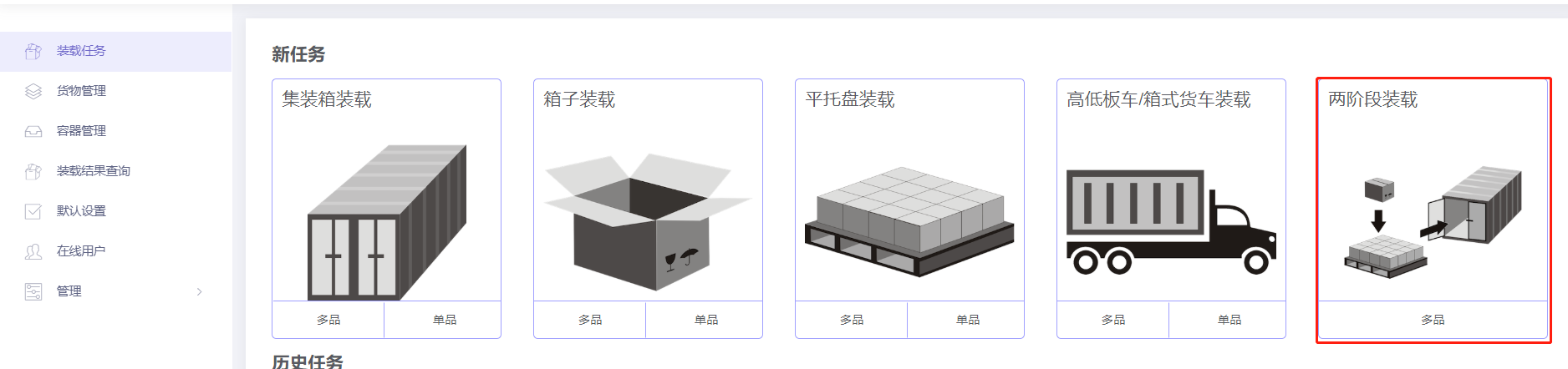
2. 2-Steps loading — first-calculation billing rule: 2-Steps loading that loads cartons onto pallets (or steel/wooden cases) and then into containers in one step
Billing formula for 2-Steps loading: [cargo rows × 2 + (containers used − 1) × 10] + number of intermediate packagings used × 1
Example: 20 rows of cargo, 50 pallets used, and 2 containers used in the end. Points = [20 × 2 + (2 − 1) × 10] + 50 = 100 points.
3. Billing rule for modifying a plan
1) Recalculating after changing placement methods, loading rules and other parameters is free.
2) Recalculating after adjusting cargo quantities up or down, where the adjusted cargo volume is within 30% of the cargo volume before adjustment, is free. Above 30% it is treated as a new calculation task and charged accordingly.
3) Adding or removing cargo rows and recalculating is treated as a new calculation task and charged accordingly.
4) Adjusting cargo dimensions is treated as a new calculation task and charged accordingly.
4. Per-use sharing billing rule
1 packing point is charged for each shared loading-task plan. Re-sharing the same plan is not charged.
5. Annual billing
For annual billing, please contact customer service: tel 010-82896870 / 010-62716964; website www.zhuangxiang.com.